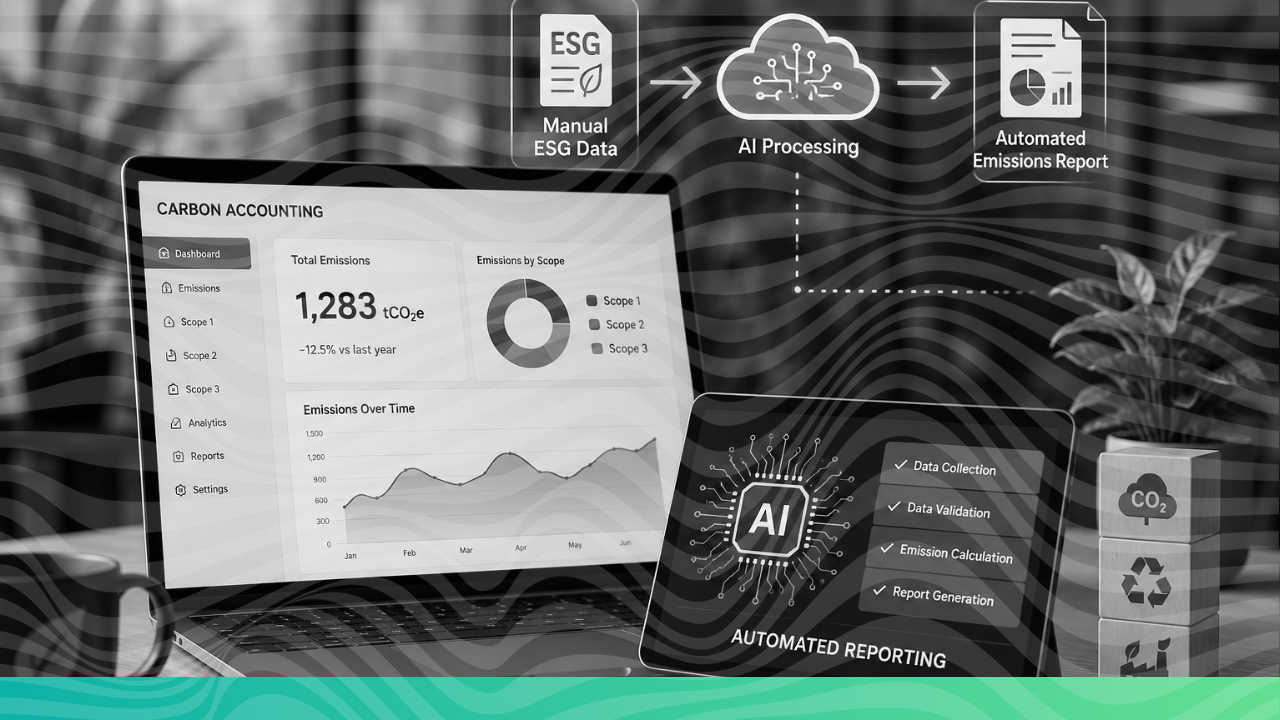

As international decarbonization mandates reshape global trade, exporting manufacturers across India, China, Turkey, South Korea, and the Middle East face an unprecedented regulatory dual-burden. With the European Union’s CBAM fully operational in its definitive phase and the United Kingdom’s Carbon Border Adjustment Mechanism (UK CBAM) coming into force on 1 January 2027, tracking embedded carbon emissions is no longer optional—it is a mandatory condition of doing business in Western markets.
Manually capturing product-level greenhouse gas emissions across complex, multi-tiered manufacturing processes using legacy spreadsheets is slow, error-prone, and exposes overseas buyers to severe regulatory penalties. To remain competitive, leading exporters are shifting toward automated carbon compliance tech stacks.
Selecting the right UK CBAM software solutions requires evaluating how effectively a platform bridges factory-floor operational data with complex border tax rules. This buyer’s guide breaks down the leading CBAM compliance approaches for global exporters in 2026/2027, comparing dedicated engines, enterprise ERP add-ons, general ESG tools, and manual processes.
Key Evaluation Criteria for UK CBAM Compliance Software
To help compliance officers, supply chain directors, and CTOs Choosing the right UK CBAM software is critical for maintaining market access and protecting export margins.
- Dual EU & UK Jurisdiction Engine: The capability to model differing regulatory boundaries—such as the EU’s inclusion of Scope 2 indirect electricity and ceramics versus the UK’s initial focus on Scope 1 direct emissions and its £50,000 import threshold.
- Automated CN/HS Code & Precursor Mapping: The ability to map 8-digit Combined Nomenclature (CN) customs codes to plant batch runs and calculate complex precursor material emissions from Tier-1 suppliers.
- Systems Integration & Data Ingestion: Seamless API connectivity with existing Enterprise Resource Planning (ERP), Manufacturing Execution Systems (MES), and SCADA platforms to eliminate manual spreadsheet entries.
- Audit Readiness & Tamper-Proof Lineage: The generation of verifiable digital audit trails that meet third-party verification standards and withstand HMRC (UK) and European Commission tax audits.
- Time-to-Value & Total Cost of Ownership (TCO): Rapid deployment capabilities that deliver buyer-ready compliance reports without requiring multi-month consulting projects or custom software builds.
Executive Summary: Top CBAM Compliance Solutions Compared
| Compliance Approach / Platform | Target Market / Best For | Dual EU/UK Compliance | Automated CN/HS Code Mapping | Implementation Timeframe | Market Verdict |
| TSC CBAM Exporter | Global exporters selling into UK & EU markets | Full Native Support (Dual-Engine Architecture) | Fully Automated (CN & Precursor Mapping) | 2 to 4 Weeks | Editor’s Choice: Purpose-built, cost-effective dedicated engine for international suppliers. |
| Enterprise ERP Modules (e.g., SAP, Oracle) | Global conglomerates with uniform single-vendor ERP setups | Partial (Requires custom localization modules) | Manual / Semi-Automated configuration | 6 to 12 Months | Powerful for internal financial flows, but slow to deploy and costly to customize for changing tax laws. |
| General ESG Platforms (e.g., Watershed, Sweep) | Corporations tracking high-level Scope 1–3 ESG disclosures | Limited (Focuses on corporate footprints rather than product SEE) | Manual mapping required | 8 to 16 Weeks | Excellent for CSRD and corporate sustainability branding; struggles with product-level border declarations. |
| Manual Spreadsheets (Excel / In-House Tools) | Micro-exporters shipping low volumes under threshold limits | None (Manual calculation formulas) | None (Manual entry) | Immediate (High ongoing labor) | High error rates, non-scalable, vulnerable to audit rejection and buyer penalty risks. |
| Pure Consulting | Large enterprises requiring full end-to-end custom advisory and hands-off execution | Custom manual advisory (Consultant-driven, no dedicated software) | Delayed (High recurring consulting fees & slow response times) | Low audit risk (if expert), but extremely expensive, non-scalable, and highly dependent on third-party availability | Low audit risk (if expert), but extremely expensive, non-scalable, and highly dependent on third-party availability |
In-Depth Evaluation of Leading UK CBAM Software Options
1. TSC CBAM Exporter
Best Overall for Exporters Supplying UK & EU Markets
TSC CBAM Exporter by The Sustainability Cloud is an enterprise-grade platform engineered specifically to solve the operational friction faced by non-EU and non-UK manufacturing exporters. Unlike generic carbon platforms, it focuses exclusively on automating border trade emissions accounting.
Key Platform Capabilities:
- Dual-Jurisdiction Rules Engine: Automatically parses data inputs through separate compliance pipelines. It calculates Specific Embedded Emissions (SEE) for EU CBAM (including Scope 1 and Scope 2 electricity rules) while simultaneously generating HMRC-compliant declarations for UK CBAM (Scope 1 direct emissions, accounting for the UK’s £50,000 threshold and sector exclusions).
- Automated Data Ingestion & SCADA Connectors: Connects via pre-built API integrations into ERP systems (SAP, Oracle, Microsoft Dynamics) and factory-floor SCADA/utility metering systems. This eliminates manual spreadsheet input errors.
- Precursor Supply Chain Architecture: Includes dedicated supplier portals allowing Tier-1 and Tier-2 precursor providers (such as raw steel billet or unwrought aluminium suppliers) to upload verified carbon intensity data directly into the platform’s mass-balance engine.
- Customs Code Mapping: Automatically matches facility production runs with official 8-digit UK Combined Nomenclature and EU CN commodity codes, ensuring accurate emission factor allocation per SKU.
- Audit-Proof Documentation: Generates standardized, exportable XML and PDF compliance packages containing complete data lineage records, ready for third-party verifiers, EU Authorized Declarants, and HMRC audits.
Verdict:
TSC CBAM Exporter is the most comprehensive, agile, and cost-effective dedicated platform available. It enables global manufacturers to transform compliance from a administrative burden into a competitive advantage when selling to Western importers.
2. Enterprise ERP Carbon Add-Ons (e.g., SAP Sustainability Footprint Management, Oracle ESG)
Best for Large Multinationals with Single-Vendor Ecosystems
While legacy Enterprise Resource Planning (ERP) vendors have introduced add-on modules, they often struggle to compete with specialized UK CBAM software designed specifically for border trade emissions.
Pros:
- Deep structural integration with existing inventory, purchasing, and bill-of-materials (BOM) data structures.
- Familiar user interfaces for corporate IT and financial accounting teams already operating within the ecosystem.
Cons:
- High Cost & Slow Deployment: Implementation typically requires extensive custom engineering, system integrator contracts, and 6 to 12 months of deployment effort.
- Lack of Legislative Agility: ERP add-ons often lag behind sudden legislative changes, such as the UK’s decision to exclude glass and ceramics or delays in Scope 2 reporting timelines.
- Customs Data Gap: Standard ERP modules track transactional costs effectively but frequently require manual workarounds to output specific EU Customs XML formats or HMRC tax returns.
Verdict:
Suitable for massive multinational conglomerates with multi-million-dollar IT budgets. However, mid-market manufacturers will find these solutions overly complex, slow to implement, and expensive to maintain.
3. General Corporate ESG & Carbon Accounting Platforms
Best for Corporate Scope 1–3 Disclosures & CSRD Reporting
General ESG platforms focus on broad corporate carbon footprints, greenhouse gas (GHG) accounting, and overarching sustainability disclosures (such as CSRD, CDP, and SECR).
Pros:
- Excellent for high-level sustainability reporting, corporate carbon footprinting, and investor-facing ESG dashboards.
- Strong capabilities for tracking corporate travel, office facilities, and high-level Scope 3 supply chain estimates.
Cons:
- Corporate vs. Product-Level Discrepancy: These platforms calculate company-wide emissions totals rather than granular Specific Embedded Emissions (SEE) per metric tonne of a specific manufactured product variant.
- Missing Border Rules: They lack built-in engines for mapping 8-digit customs codes, applying Carbon Price Relief (CPR) offsets, or generating regulatory-compliant border declaration templates for HMRC or EU customs.
Verdict:
Valuable for corporate sustainability leads working on annual CSR reports, but insufficient as specialized UK CBAM software for export compliance teams facing border tax liabilities.
4. Manual Spreadsheets & Custom In-House Builds
Best for Low-Volume Exporters Operating Below Threshold Limits
Many exporting firms initially attempt to manage CBAM compliance using static Excel spreadsheets or basic in-house database tools.
Pros:
- Zero upfront software licensing fees.
- Complete internal control over initial calculation templates.
Cons:
- High Financial & Operational Risk: Spreadsheets lack automated data validation, version control, and audit trails. A single formula error can lead to incorrect carbon declarations, resulting in financial penalties or rejected shipments.
- Data Collection Bottlenecks: Manually aggregating monthly utility invoices, production weights, and supplier precursor sheets across multiple plant sites requires hundreds of staff hours per reporting cycle.
- Non-Scalable: As regulatory deadlines approach and quarterly reporting rhythms intensify, spreadsheet management becomes an operational bottleneck.
Verdict:
Only viable for micro-exporters whose aggregate annual export values to the UK remain safely below the £50,000 threshold. For commercial exporters, relying on spreadsheets instead of dedicated UK CBAM software represents an unacceptable audit risk.
Why Global Exporters Choose Dedicated CBAM Automation
Investing in specialized UK CBAM software delivers immediate operational benefits across the export value chain:
- 80% Reduction in Administrative Costs: Automating data collection from ERPs and utility systems eliminates hundreds of hours of manual entry per quarter.
- Protection of Profit Margins: Primary facility data prevents the application of punitive government default rates, ensuring UK and EU importers pay the lowest legitimate carbon tax rates.
- Seamless Commercial Relationships: Providing overseas buyers with instant, audit-ready carbon declarations eliminates trade friction and positions your business as a preferred vendor.
- Future-Proof Compliance: Specialized software platforms update calculation rules automatically as regulations evolve across global markets.
FAQs
Corporate ESG software calculates company-wide emissions footprint totals. CBAM regulations require granular, product-level Specific Embedded Emissions (SEE) tied directly to 8-digit Combined Nomenclature (CN) customs codes. Dedicated platforms like TSC CBAM Exporter bridge this gap by calculating emissions per metric tonne of specific manufactured goods.
No. Hydrogen and electricity are explicitly excluded from the 50-tonne de minimis exemption. Every consignment of imported hydrogen is subject to mandatory CBAM monitoring and financial obligations.
A dedicated dual-engine platform automatically applies the correct regulatory rules based on the destination market. For instance, when exporting to the EU, it calculates Scope 1 and Scope 2 emissions across covered sectors. For UK exports, it isolates Scope 1 direct emissions, excludes glass and ceramics, and applies HMRC tax reporting formats automatically.
While enterprise ERP modules take 6 to 12 months to configure, purpose-built platforms like TSC CBAM Exporter can be deployed in 2 to 4 weeks via standard API connectors and pre-formatted supplier data templates.
Yes. Advanced CBAM platforms feature secure supplier portals. Tier-1 raw material suppliers (such as steel billet or raw aluminium producers) can log in, submit their facility carbon metrics, and have those values automatically incorporated into your final product’s mass-balance calculations.