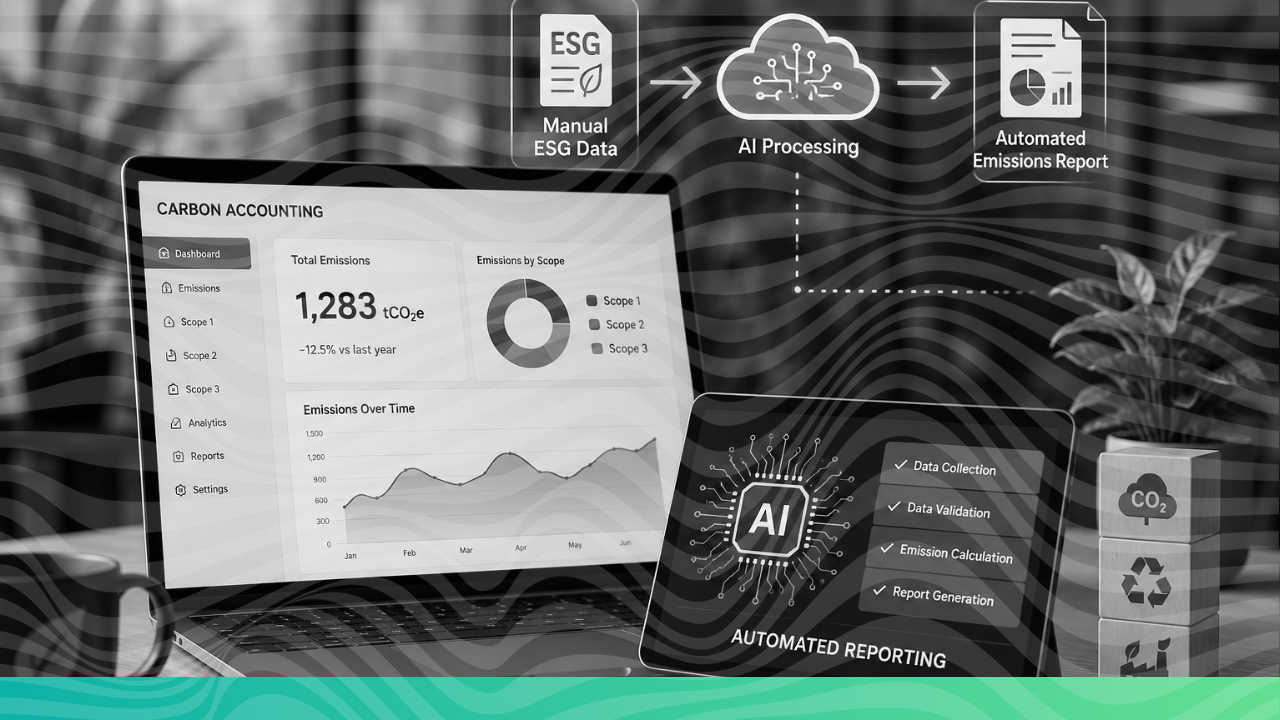
AI carbon accounting is rapidly transforming corporate sustainability, replacing slow spreadsheets with automated emissions tracking. For years, corporate sustainability teams have shared a common struggle: managing carbon accounting through endless spreadsheets, disconnected utility bills, and manual data entry.
For years, corporate sustainability teams have shared a common struggle: managing carbon accounting through endless spreadsheets, disconnected utility bills, and manual data entry.
With strict global mandates like the EU’s Corporate Sustainability Reporting Directive (CSRD), the Carbon Border Adjustment Mechanism (CBAM), and SEC climate disclosures taking full effect in 2026, manual ESG tracking is no longer just slow—it is a business risk.
Artificial intelligence has officially transformed carbon accounting from a once-a-year manual audit into a real-time, automated operational system.
The Death of Manual ESG Spreadsheets
Historically, calculating a company’s carbon footprint meant collecting invoices, converting units by hand, and guessing supply chain emissions months after the year ended.
This legacy approach creates three major operational problems:
- Human Error & Audit Flags: Manual entry across complex facility data leads to calculation mistakes, exposing companies to regulatory fines and greenwashing accusations.
- Data Lag: Annual carbon reports show what happened 12 months ago, making it impossible to adjust sustainability strategies in real time.
- Supply Chain Blind Spots: Collecting primary carbon data from hundreds of Tier-1 and Tier-2 suppliers via email forms results in low response rates and unverified estimates.
In 2026, AI carbon accounting platforms solve these challenges by automating data collection, mapping emissions factors instantly, and delivering audit-ready reports.
4 Ways AI Automates Carbon Accounting in 2026
1. Smart Invoice Processing & Utility Data Extraction
Instead of manually typing numbers from utility bills, AI uses Optical Character Recognition (OCR) and Natural Language Processing (NLP) to read energy invoices, fuel logs, and utility bills instantly. The system automatically categorizes energy usage and converts raw consumption data into precise CO₂ equivalent metrics ($Scope\ 1$ and $Scope\ 2$).
2. Automated Scope 3 Supply Chain Intelligence
$Scope\ 3$ indirect supply chain emissions account for over 80% of most corporate carbon footprints. AI algorithms analyze corporate procurement data, ERP systems, and purchase orders to map suppliers to global emissions factor databases automatically. When supplier data is missing, predictive AI models estimate carbon intensity accurately until verified primary data is collected.
3. Automated Emission Factor Matching
Matching procurement spend to correct emission factors (such as DEFRA, EPA, or EXIOBASE) used to take external consultants weeks. AI engines continuously evaluate spend descriptions, product codes, and material types to match purchase items with the correct regional emission factor automatically, reducing calculation errors down to near-zero.
4. Continuous Audit-Ready Compliance
Instead of scrambling before annual reporting deadlines, modern AI carbon accounting systems run continuous audits on incoming carbon data. Machine learning algorithms flag data anomalies—such as an unexpected spike in factory energy use—and alert compliance teams before inaccuracies reach official sustainability disclosures.
Manual ESG vs. AI-Powered Carbon Accounting
| Operational Area | Legacy Manual ESG | AI-Powered Carbon Accounting (2026) |
| Data Collection | Manual spreadsheet entry & email chains | Automated ERP, API, & invoice OCR integration |
| Calculation Speed | Weeks or months per reporting cycle | Real-time continuous emission updates |
| Scope 3 Visibility | Industry averages and rough estimates | Direct supplier mapping & predictive analytics |
| Audit Readiness | High risk of errors and missing documentation | Immutable digital trail & automated anomaly detection |
| Resource Cost | High dependency on manual consulting hours | Automated software workflows with minimal overhead |
The Business Value: Moving from Compliance to Cost Savings
Adopting AI carbon accounting isn’t just about avoiding regulatory penalties – it directly impacts your bottom line.
- Operational Cost Reduction: Automating data ingestion reduces the internal staff hours and consulting costs required to prepare annual ESG reports by up to 70%.
- Supply Chain Optimization: Real-time visibility allows procurement teams to select low-carbon suppliers, reducing future carbon tax liabilities under policies like CBAM.
- Capital Access: Financial institutions increasingly link commercial lending rates and investment decisions to verified ESG performance. AI-certified data provides the transparency investors demand.
How The Sustainability Cloud Accelerates AI Carbon Accounting
At The Sustainability Cloud, we help global enterprises replace static ESG spreadsheets with intelligent, automated carbon management:
- Instant Data Connectors: Sync directly with your existing ERP, utility, and supply chain management tools via pre-built APIs.
- Automated Scope 1-3 Engine: Compute real-time emissions data compliant with the GHG Protocol, CSRD, and CBAM standards.
- Supplier Data Hub: Engage your supply chain with automated tracking workflows to collect verified primary carbon data.
- Audit-Grade Verification Reports: Generate standardized ESG and climate disclosures ready for third-party auditors at the click of a button.
Upgrade Your ESG Reporting Workflow Today
Manual spreadsheets are a legacy tool in an automated world. By adopting AI-driven carbon accounting in 2026, your business turns ESG compliance from a slow administrative burden into a competitive advantage.
- Want to review how global trade rules are changing? Read our guide on Navigating the EU CBAM Definitive Regime.
- Learn how technical rules impact supply chains in CBAM Technical Rules & Precursor Tracking.
Ready to automate your corporate emissions reporting?
Book a Demo with The Sustainability Cloud today and see AI carbon accounting in action.
FAQs
No. AI automates data collection, emission factor matching, and calculation workflows, but human expertise is still essential for strategic planning, climate target setting, and final audit reviews.
AI systems track primary emission data in real time and automatically structure disclosures to meet specific regulatory frameworks like CBAM, CSRD, and ISSB, ensuring your reporting stays current with changing legislation.
Yes. Enterprise AI carbon accounting platforms use enterprise-grade encryption, secure API connections, and strict data governance policies to protect sensitive operational and financial information.