

CBAM compliance for Vietnam may cost manufacturers upwards of 25% in export costs. From a macroeconomic purview, this could vary from 35-40% for aluminum and 15-20% for steel manufacturers.
In the case of steel, the local carbon intensity of 2.51 tCO₂e/t leaps well beyond global averages. Being the EU’s most high-value ASEAN trading partner, carbon border taxes under CBAM Vietnam frameworks need to be curtailed to continue securing European buyer contracts.
Electronics, textiles, footwear, machinery, and furniture companies (maximum sourcing from Vietnam) entering the EU need well-documented, verified emissions data across their value chains. Let’s see how choosing a CBAM compliance software for Vietnam can relieve you of constant dominoes in the EU energy-carbon market.
Why CBAM Vietnam Mandates Require Urgent Carbon Tracking
The degree of administrative leniency allowed during the transitional phase of CBAM Vietnam compliance for exporters has passed. Using regional default values and country-level sector averages no longer works for carbon bookkeeping under the new CBAM Vietnam guidelines.
European importers now face severe financial penalties for inaccurate carbon filings. This pushes the burden of proof entirely downhill to the factory floors of Bing Duong, Dong Nai, and Haiphong.
- Default carbon accounting structures will heavily penalize data gaps. As Vietnam’s steel emissions are sky-high, failure to optimize real-time reporting may subject shipments to peak EU carbon border taxes.
- EU importers are now actively decoupling from unverified supply chains in favor of vendors that provide automated data trails.
- Heavy buyers of Vietnamese electronics, apparel, and machinery are initiating preemptive supplier data programs. This helps insulate their entire manufacturing base before the next phase of EU mandates.
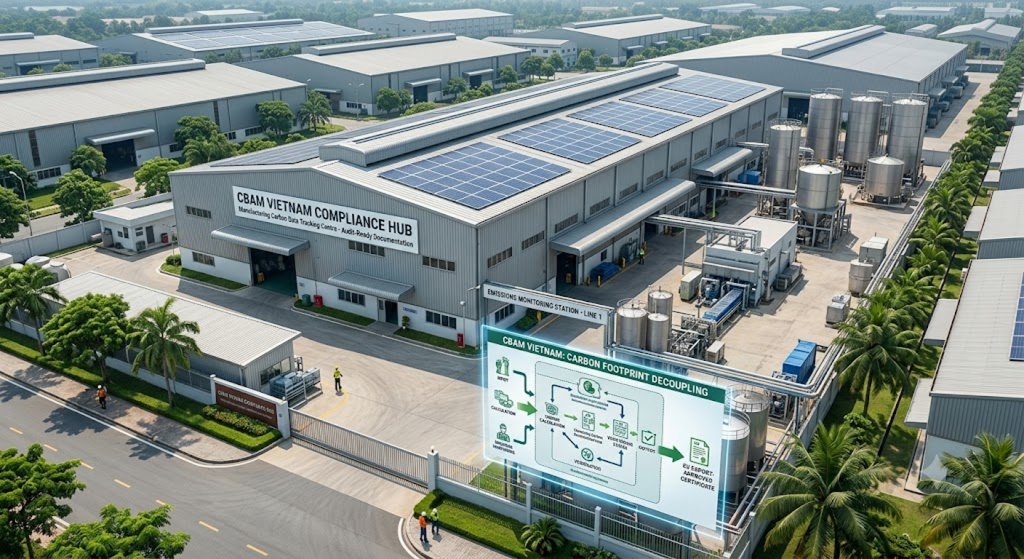
5 Critical CBAM Vietnam Prep Steps Before EU Reporting
Let’s see how CBAM compliance for Vietnam exporters can avoid multiple reverification rounds after initial reporting.
Prove the Origin and Production Route for CBAM Compliance Vietnam
Exported products generally pass through sub-tier suppliers and facilities or processing zones before final export. This can fragment how you track the accumulation of embedded emissions.
If a primary metal is smelted in one facility, rolled in another, and finished in a third, the data trail must remain unbroken. In fact, if the final CBAM file shows only a single average emissions value, the EU buyer may not have sufficient evidence to trust the number.
Here’s what a strong product-origin file should do:
- Match the product with the relevant CN code before preparing the file.
- Map the facility and production lines, including outsourced processing locations.
- Record data about scrap content, billet and slab source, alloy mix, and additional raw materials.
- Maintain an evidence pack with categorized supplier documents and production logs.
Prove the Origin and Production Route for CBAM Compliance Vietnam
Unlike many developed nations, Vietnam’s grid relies heavily on coal thermal power. Thus, default grid emission factors are inherently high. If you’re operating an energy-intensive production line, your product’s embedded emissions reporting under CBAM Vietnam guidelines inflates automatically unless you can prove otherwise.
Note that European steel and aluminum importers, whether in Rotterdam or Frankfurt, face strict financial exposure for these emissions. This means they will be thorough when cross-examining how much power your factory consumed and how it was sourced.
Consider a factory floor running multiple production lines. Line A exports high-grade steel for the EU. Line B handles low-spec structural steel for domestic markets. Averaging both utility bills across the complete facility will equate to the EU-bound shipment absorbing an unfair share of the factory’s total carbon loan. In short, exporters need to isolate line-level meter readings to avoid EU buyers from choosing worst-case (default) emissions assumptions.
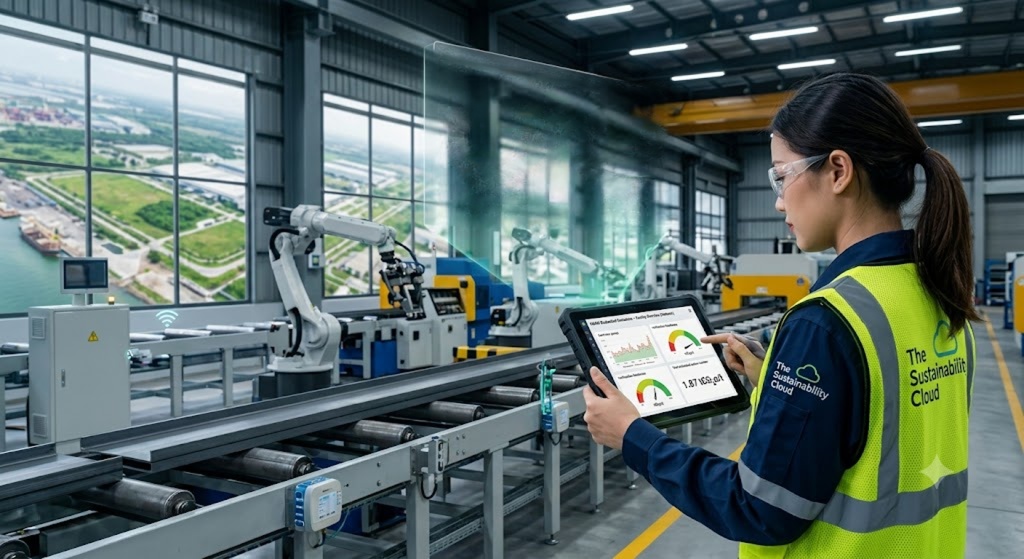
Energy management software from The Sustainability Cloud lets you monitor asset-level energy metrics and set notifications for anomalies such as leaks. Leverage pre-installed visual diagrams to study your exported product’s energy consumption patterns and report Scope 2 emissions better than manual processes.
Build a supplier emissions data program before EU buyers force one
A customized supplier emissions data program for CBAM Vietnam compliant exporters needs to distinguish high-impact suppliers from low-impact vendors. Prioritize fertilizer feedback, aluminum inputs, and fuel-related suppliers first. Next, ask suppliers for information in a consistent format. If not, procurement teams might receive Excel files and email statements with incomplete declarations that cannot be compared.
Another key point is to grade their data quality. Give your team visibility of reporting risks by keeping grading options like:
- Actual
- Partially supported
- Estimated
- Missing
Organize a verification readiness review
Assume an exporter claims a lower embedded carbon footprint by using a specific batch of scrap metal. Then they must prove that exact batch went into the specific EU-bound production run.
If your internal records show a data error or discrepancy between the purchase date of low-carbon inputs and the actual smelting timeline, an auditor will reject the claim. The system will default your shipment to the highest regional carbon penalty, wiping out your margin. Thus, it’s better to use audit-ready documentation trails rather than theoretical compliance.
Did You Know: EU importers bringing in more than 50 tons of CBAM goods should be officially authorized and purchase CBAM certificates to compensate for the value-chain carbon released.
Run a CBAM reporting simulation using a recent EU shipment
The most practical preparation exercise a manufacturer can perform is a dry run. Select a single, high-value shipment sent to Europe over the last quarter and attempt to recreate a flawless and end-to-end CBAM reporting package for it.
This simulation helps refine your CBAM Vietnam readiness and forces your teams to cross departmental silos. Even better, it tests how they connect factory floor operations with logistics and legal. For instance, you can identify a workflow problem if one shipment’s data takes 5 weeks of internal chasing.
Test dedicated CBAM Vietnam reporting software to run automated data-assessment simulations across your entire value chain. Our supplier portal can send instant reminders to your vendors to create draft or final EU CBAM reports.
FAQs
Conclusion: Securing Your EU Export Route
Achieving CBAM compliance in Vietnam is no longer a future projection—it is an active business requirement. By structuring your carbon accounting models, utilizing automatedenergy management software from The Sustainability Cloud, and running simulated trials today, Vietnamese manufacturers can secure their supply chains. Do not wait for 2027; take control of your emissions data now to protect your partnerships and maintain your competitive edge in the European market.