

While CBAM software for steel exporters can consolidate all data into compliant formats, emissions data is initially scattered across production records, utility bills, supplier declarations, spreadsheets, and multiple internal teams. This means reporting errors frequently occur long before embedded emissions calculations begin.
For steel exporters supplying the EU, these mistakes can increase reliance on default values and make it harder to demonstrate actual emissions performance.
Indian aluminum exports to the EU have already fallen by 41% due to CBAM pressures, signaling what’s at stake for steel as well. This article examines the most common data errors in steel CBAM reporting, where they occur, and what exporters can do to reduce them before verification.
Where does embedded emission data for steel exporters comes from?
Every CBAM report relies on data collected from different parts of the organisation. If one link in that chain is incomplete or inaccurate, the final emissions calculation can be affected.
| Data Source | Typical Owner | Common Risk |
| Raw material inputs | Procurement | Missing supplier emissions information |
| Production records | Operations | Volume mismatches |
| Fuel consumption | Plant teams | Incomplete activity data |
| Electricity consumption | Utilities/Operations | Incorrect emission calculations |
| Emission factors | Sustainability teams | Outdated or inappropriate factors |
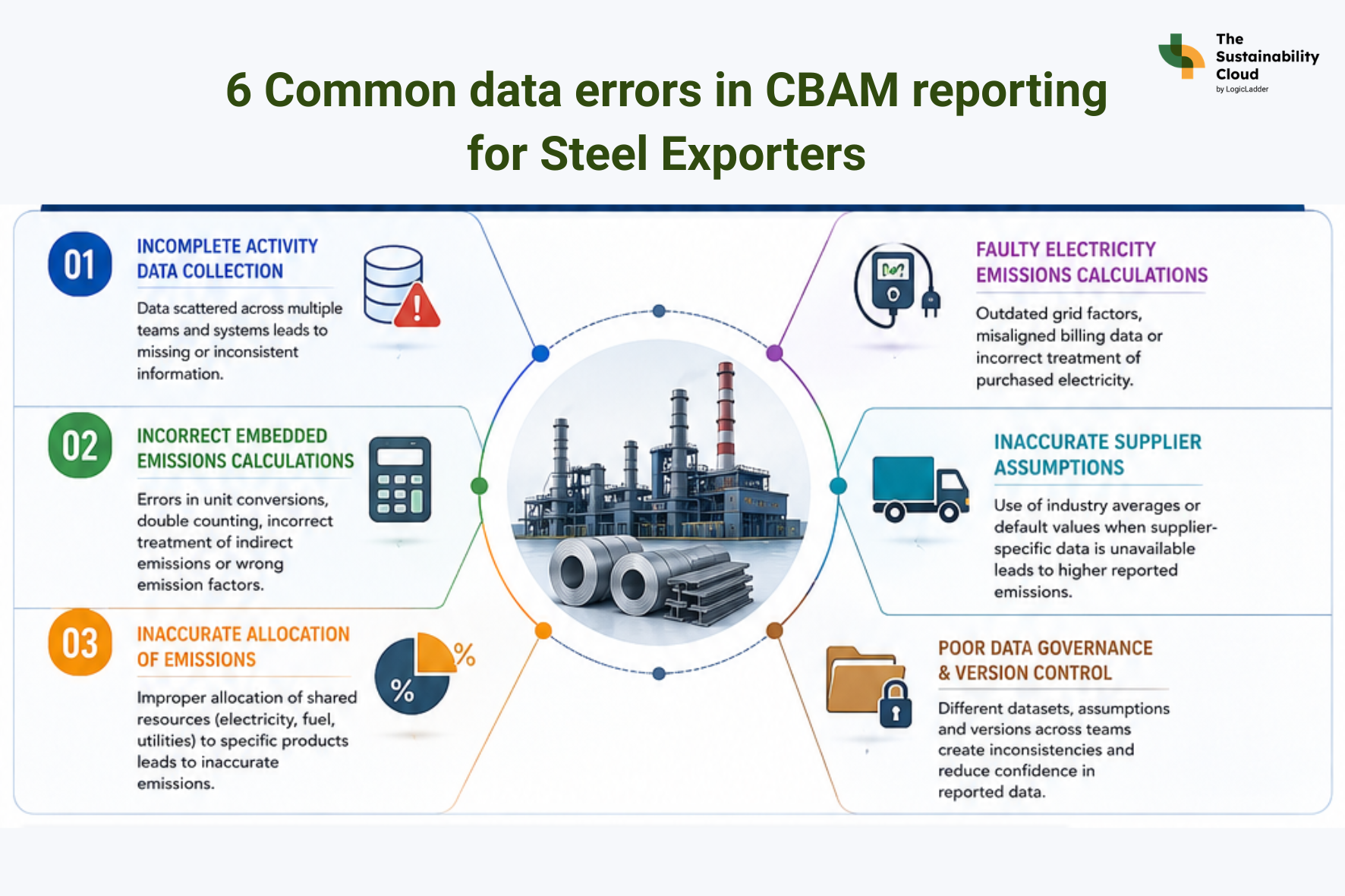
6 Common Data Errors in CBAM Reporting for Steel Exporters
CBAM certificate prices are expected to approximately mirror prices in the EU ETS. As of Q1 2026, CBAM certificates are priced at €75.36 per tonne of CO₂ during recent years. Thus, even relatively small data errors can largely spike up carbon costs. Here are frequent red flags when steel exporters calculate embedded emissions for CBAM:
1. Incomplete activity data collection
Activity data for steel exporters generally includes fuel and electricity consumption, raw material inputs, production volumes, and process-specific operating data. The challenge is that this information rarely sits in a single system.
Procurement teams manage raw material records. Operations teams track production volumes. And sustainability teams are often responsible for consolidating everything into a CBAM-ready format. These coinciding tasks can make data collection incomplete and erroneous.
Consider a steel manufacturer operating three plants that supply multiple EU customers. Even before emissions calculations begin, the company may need to consolidate data from dozens of internal sources and external suppliers.
2. Incorrect embedded emissions calculations
Steel exporters must apply the correct calculation steps once activity data is collected. These steps are prescribed by the EU, especially for CBAM. Those that rely on internal carbon accounting approaches, which are primarily manual, tend to suffer from reporting inconsistencies. Adopting a CBAM-compliant software will automatically follow the EU protocol, such as:
- Incorrect unit conversions
- Double-counting emissions sources
- Incorrect treatment of indirect emissions
- Applying inappropriate emission factors
3. Inaccurate allocation of emissions to production routes
Many facilities manufacture multiple steel products using shared infrastructure. In fact, electricity, fuel, compressed air systems, and common utilities may support several production lines simultaneously. However, CBAM reporting requires exporters to break down how emissions associated with shared resources have been allocated to specific products.
For instance, let’s say a facility produces both hot-rolled coils and steel sheets using standard utility systems. If 10,000 MWh of electricity use is recorded at the facility level, exporters must establish a defensible method to allocate those emissions to individual products.
Use ESG SaaS tools, like TSC’s Net Zero software for enterprises, to automate validations and QA across several emissions allocations. The ‘matching matrix’ tool helps maintain a high level of consistency across reports.
4. Faulty electricity emissions calculations
Electricity-related emissions can have a material impact on CBAM embedded emissions calculations. Expect this in electric arc furnace (EAF) operations where electricity is a major production input. Most issues here spin around outdated grid emission factors or a misalignment between billing data and production periods. Another cause of concern is the inconsistent treatment of purchased electricity.
The European Commission has published detailed guidance regarding the calculation of indirect emissions and electricity-related reporting requirements. Exporters should ensure that electricity evaluations are done with the latest guidance on CBAM embedded emissions calculations rather than relying on historical sustainability reporting practices.
5. Inaccurate supplier assumptions
CBAM reporting becomes more complicated when supplier-specific emissions information is unavailable. In these situations, companies may rely on assumptions, industry averages, or default values, which are generally higher than the original.
A supplier may have significantly different emissions performance compared to industry averages. Similarly, emission factors that are appropriate for one geography or reporting framework may not be appropriate for CBAM calculations.
This is one reason why the debate around CBAM default values versus actual emissions is becoming increasingly important.
Also Read: CBAM 2026 (What Has Changed and What You Must Do Now)
Bonus: Use this CBAM data quality checklist for steel exporters
6. Poor data governance and version control
The collaboration between multiple teams across various reporting cycles and datasets makes space for data errors in CBAM reports. A lack of clear governance systems and SOPs might make companies lose confidence in their own reporting data. Here’s what sustainability and ESG analysts must be careful of:
- Different teams using different versions of energy or supplier datasets create inconsistencies during CBAM data consolidation
- Emission factors updated without documentation make it difficult to explain changes in reported emissions between reporting periods
- Applying different assumptions across facilities or reporting cycles results in CBAM embedded emissions calculations that are challenging to compare
One should consider tracking 1200 ESG datapoints in an all-inclusive ESG bookkeeping tool that manages your stakeholder data along with report comparisons and KPI progress. The Sustainability Cloud’s Net Zero software is built with sustainability reporting and compliance parameters that are traceable across scope 1, 2, and 3 accounting for GHG emissions. Overall, companies retain 100% control over year-to-year ESG reports and can adjust emissions-based KPIs accordingly.
Calculate your embedded emissions with our CBAM reporting software for exporters