

Finding the best ESG reporting software for Indian companies is now a top priority for sustainability leaders. Did you know that almost 40% of the time spent on corporate ESG reporting is wasted in sorting and cleaning data? While a feature-packed ESG software solution in India can automate this process, 83% of companies reviewed in a regulatory analysis of NSE BRSR filings still manually use spreadsheets.
Expert studies by Ernst & Young, in collaboration with CII (Confederation of Indian Industry), highlight that 73% of Indian organizations will fall considerably short of meeting ESG disclosure requirements. The compliance perimeter has grown to include value chain disclosures (Scope 3) for the top 250 Indian entities. This constant revision and expansion mean your company cannot rely on ad hoc methods as before.
If you’re wondering how to start ESG reporting in India, this article highlights the necessary features that the best ESG reporting software for Indian companies must have.
Key Features of the Best ESG Reporting Software for Indian Companies
Standard dashboarding features are outdated when choosing a sustainability reporting software in India. Let’s see which features can help you fulfill ESG compliance in India without too much manual intervention:

5 suggestions for Vietnam exporters before EU CBAM reporting
Let’s see how CBAM compliance for Vietnam exporters can avoid multiple reverification rounds after initial reporting.
Report for multiple frameworks from a single dataset
Indian enterprises cannot afford to run separate, siloed data-collection streams for every individual disclosure framework. The best ESG reporting software for Indian companies should offer a centralized data model to streamline disclosures.
Cross-framework mapping: Enter a data point once (such as metric tons of hazardous waste generated) and automatically map it to BRSR, IFRS S1 & S2 (ISSB), GRI, and CDP.
Dynamic data harmonization: The software should be designed to turn raw metrics into the precise reporting formats, terminology, and units required by different global and domestic regulatory bodies simultaneously.
Offer built-in audit trails and “doer-checker” evidence management
Greenwashing and data errors are almost treated with the same severity by ESG regulators. Some even consider declaring financial misstatements as a huge red flag:
- Immutable activity logs: This system needs to be tamper-free. It stands for every data entry and calculation entry or configuration adjustment. Provided the ESG software generates unchangeable, time-stamped trails showing the user identity and previous values, your chances of 100% compliance are higher.
- Source-to-disclosure linking: Auditors must be able to click on a final emissions figure in a report. Directly drilling right down to the uploaded source document, such as a factory PDF utility bill, makes root verification easier across your overall ESG report.
- Dual-authorization workflows: Built-in financial-grade “maker-checker” workflows guarantee that your facility-level data cannot reach the corporate disclosure level. Such data should be revealed only after verification via multi-tiered internal procedures.
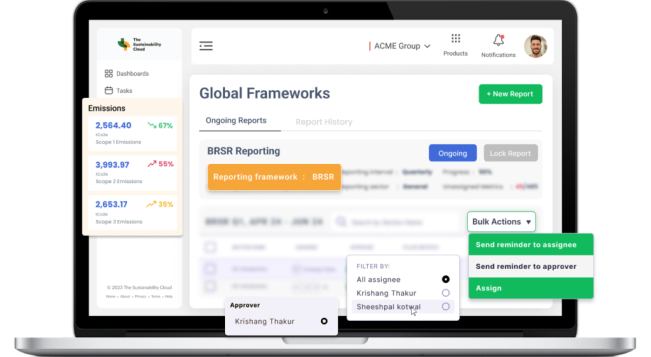
Provide supplier and Scope 3 portals with automated reminders
Scope 3 emissions continue to be the largest share of a company’s carbon footprint. It’s yet the hardest data to collect. Look for ESG software in India with vendor-facing onboarding portals that allow tier-1 and tier-2 suppliers to upload their waste data and safety metrics easily. Rather than manual follow-ups, ESG platforms should trigger scheduled data requests and issue automated reminders to non-compliant suppliers.
Another dealbreaker is a hybrid estimation model. The platform should apply spend-based or industry-average lifecycle emission factors to brush up on missing primary data.
Manage facility-level and business-unit-level data
Large Indian companies have complex corporate structures with joint ventures and subsidiaries. An ESG platform must permit users to configure customer operational boundaries and aggregate data from different parent entities and their smaller units.
Above this, direct ERP and ledger integration is a big bonus. If it’s advanced ESG software in India, it might even connect directly via APIs to ecosystems such as SAP, Oracle, or Tally. Such cross-linkages let the system extract material purchases and utility costs without the headache of follow-ups.
Additionally, you can finally give up on post-verification manual accounting entries. The Sustainability Cloud lets you connect to operational technology (OT) networks like SCADA or other industrial IoT devices. When you can pull raw energy and environmental data live from the shop floor, reporting accuracy becomes a certainty.
Use advanced emission engines with Indian factor libraries
When evaluating the best ESG reporting software for Indian companies, generic emission calculation engines often fall short because they rely on US-centric databases. This can inaccurately report for regulations and operations in India. Look for an ESG platform with localized grid factors. Ideally, it must natively integrate such regional data, such as specific grid carbon intensities published by the Central Electricity Authority (CEA) of India.
Choose automated engines built on the GHG protocol that calculate Scope 1-2 and all 15 categories of Scope 3 emissions. It’s best if the software handles both location-based and market-based electricity calculations.
Platforms like The Sustainability Cloud’s NetZero feature an auto-updated database containing over 45,000 localized and international emission factors. This includes CEA and IPCC values pre-stored with multi-version Global Warming Potential tracking. All in all, your facilities in various Indian states can conveniently track their GHG emissions in sync with local grid units.
Detect anomalies for better assurance standards
Facing data errors during an external audit will delay your verification process and double the risk of non-compliance. Ultimately, the best ESG reporting software for Indian companies should use automated baseline modeling to flag erratic data entries in real time.
Let’s say a plant manager inputs a fuel receipt that introduces a 30% spike in facility-level consumption compared to historical seasonal baselines. Systems should automatically flag such entries for review before publishing the data.
Lastly, built-in validation rules can check files for unsigned approvals or uncalibrated sub-meter data. This keeps your data room clean before external auditors arrive.
FAQs