

As part of the EU CBAM Definitive Regime, the European Union’s Carbon Border Adjustment Mechanism (CBAM) has officially entered its definitive phase. The European Commission released 10 foundational guidance documents on 14th August designed to explain the transition from administrative reporting to direct financial enforcement.
For global manufacturers exporting carbon-intensive goods into the EU internal market, the rules of trade have fundamentally changed. Compliance is no longer about estimating emissions on quarterly spreadsheets—it is a verified border adjustment tax that directly impacts profit margins, supply chain pricing, and contract terms.
Below is an in-depth breakdown of the major structural shifts, key statutory timelines, verification requirements, and financial formulas governing the definitive period.
Understanding the EU CBAM Definitive Regime: 2023–2025 vs. 2026 Onward
To navigate compliance effectively, global exporters and EU importers must recognize that the transitional grace period is over.
Between 1 October 2023 and 31 December 2025, CBAM functioned purely as an administrative data collection trial. Importers submitted quarterly reports detailing embedded carbon without incurring financial adjustments or requiring independent audits.
As of 1 January 2026, the regime requires a four-pillar compliance framework:
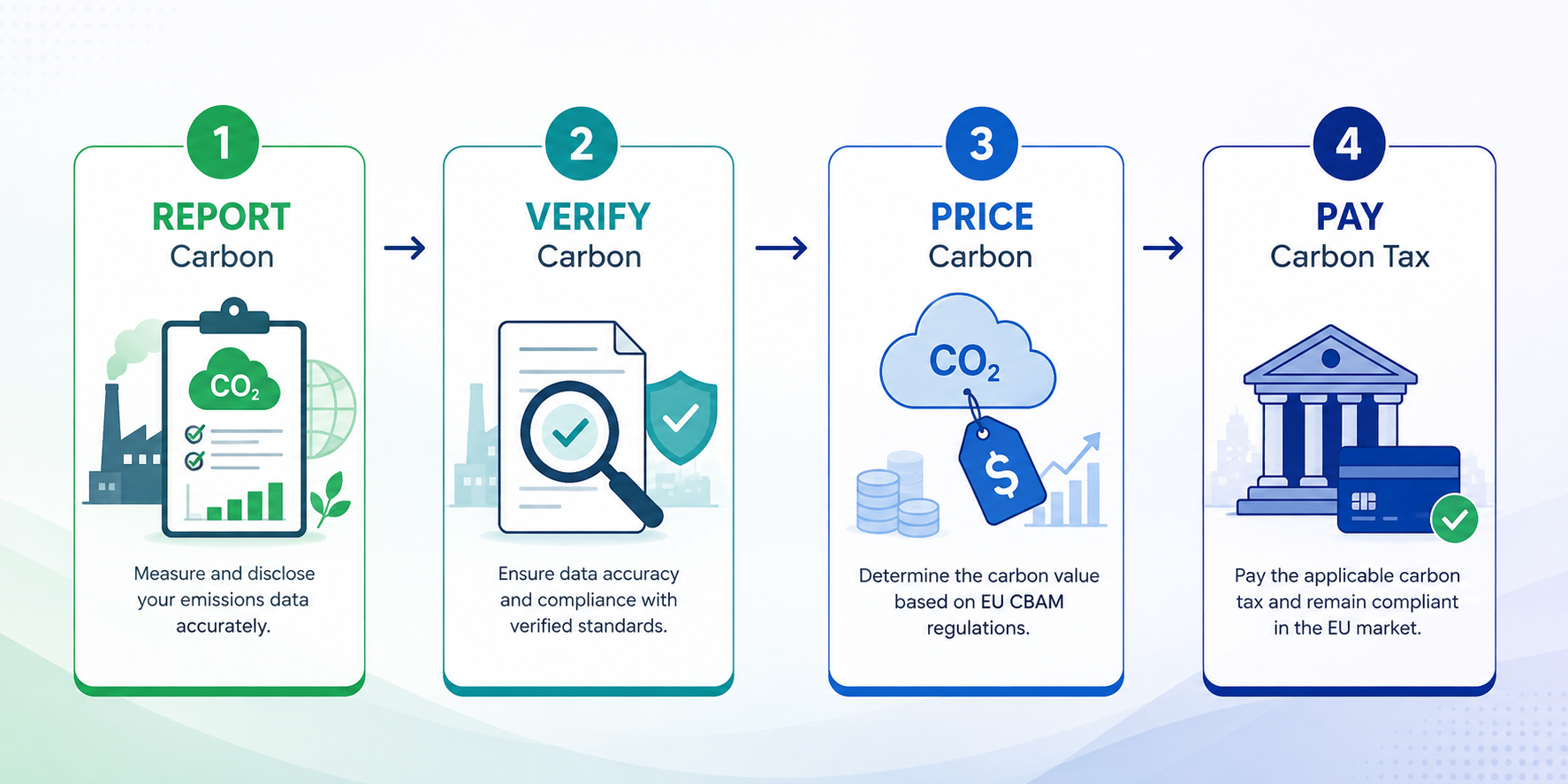
1. Comparative Breakdown: Transitional vs. Definitive Phase
| Compliance Feature | Transitional Phase (2023–2025) | Definitive Phase (2026 Onward) |
|---|---|---|
| Primary Goal | Data collection & methodology testing | Carbon leakage prevention & border pricing |
| Reporting Frequency | Quarterly reporting submissions | Annual calendar year CBAM Declarations |
| Financial Liability | Zero financial penalty or certificate purchases | Mandatory purchase and surrender of CBAM Certificates |
| Data Verification | Unverified primary data or default values permitted | Mandatory third-party accreditation & audit verification |
| Import Status | Standard customs clearance | Requires registered Authorized CBAM Declarant status |
2. From Quarterly Reports to Annual Declarations: Key Timelines
Under the definitive framework, the burden of quarterly administrative filings has been replaced by a single, comprehensive Annual CBAM Declaration. However, the compliance calendar introduces strict statutory milestones that businesses must map into their financial accounting cycles.
- 1 January 2026: The definitive period begins. Importers and overseas production facilities must collect verified facility-level embedded carbon data across all covered shipments.
- 1 February 2027: Official sales of CBAM certificates launch on the EU central platform. Certificate prices are tied to the weekly volume-weighted average clearing price of EU Emissions Trading System (EU ETS) auctions.
- 30 September 2027: The statutory deadline for the first Annual CBAM Declaration covering all goods imported during the 2026 calendar year. On or before this date, Authorized Declarants must surrender the corresponding number of CBAM certificates to cover their total verified embedded emissions.
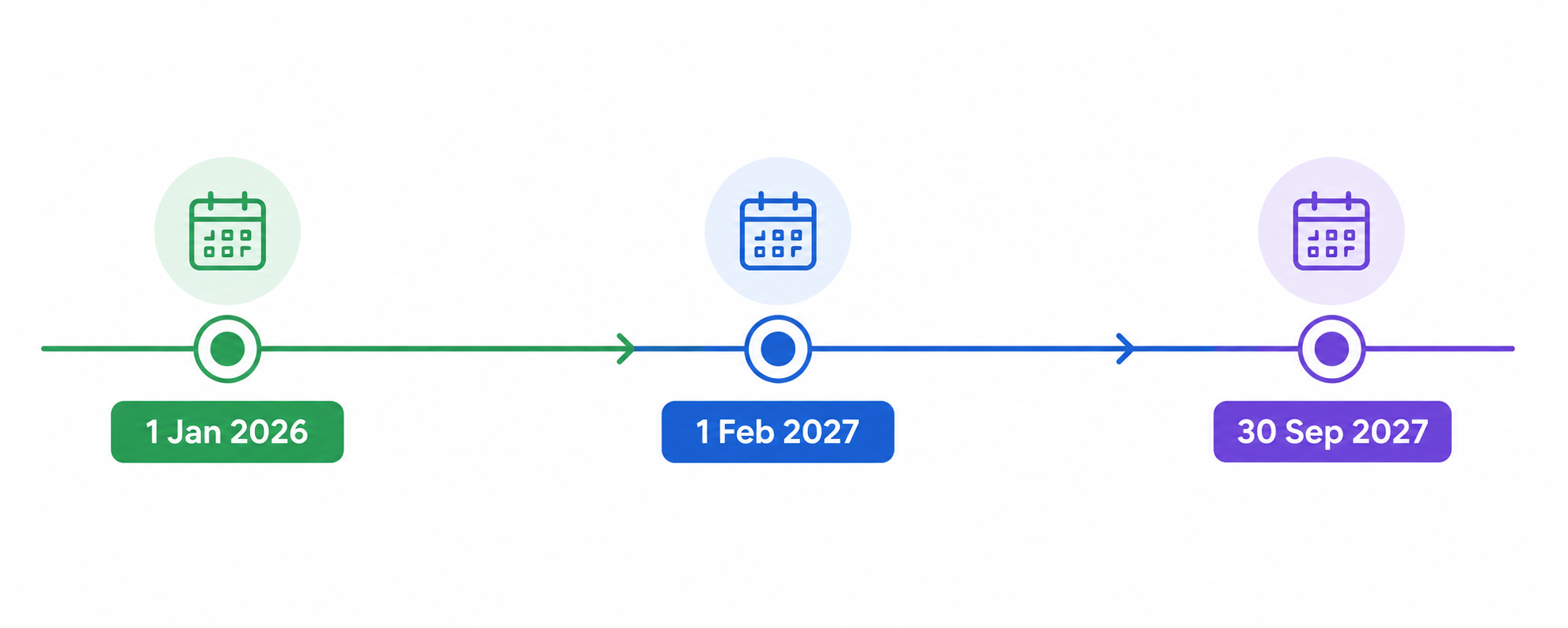
- 1 January 2026: Definitive Scheme Launch & 2026 Carbon Data Logging Begins
- 1 February 2027: CBAM Certificate Sales Open on Central Platform
- 30 September 2027: First Annual Declaration & Certificate Surrender Deadline
Operational Insight: While the financial surrender date falls on 30 September 2027, importers must maintain a quarterly holding of at least 50% of the required CBAM certificates corresponding to embedded emissions accumulated since the start of the calendar year. This prevents end-of-year liquidity bottlenecks and forces continuous carbon accounting.
3. Actual Emissions vs. Default Values: The Financial Penalty Risk
A core message emphasized across the European Commission’s August 2026 guidance package is that data quality now carries direct financial consequences.
Overseas manufacturers can report carbon metrics using two primary paths:
Path A: Primary Verified Actual Emissions
Exporters calculate facility-specific direct emissions (and eligible indirect emissions) using real-time fuel, process, and energy metering data. These calculations must be independently audited and verified by an EU-accredited third-party verifier prior to submission.
Path B: Commission Default Values
If an overseas production facility fails to provide verified primary carbon data, the EU importer is forced to apply standard Commission Default Values.
The Default Value Penalty: Default values are deliberately constructed using conservative, high-carbon benchmarks (typically representing the top percentile of emission intensity). Relying on default values significantly artificially inflates the number of CBAM certificates an importer must buy, placing non-compliant exporters at an immediate price disadvantage compared to competitors offering primary verified metrics.
4. Deconstructing the CBAM Financial Formula
Your actual CBAM financial obligation is not a simple calculation of total carbon footprint multiplied by certificate price. The European Commission’s Guidance Document No. 4 establishes a precise net-liability formula designed to account for domestic free allowances and overseas carbon pricing:
$$\text{Net CBAM Certificates Payable} = \left( \text{Total Embedded Emissions} – \text{Free Allocation Adjustment} \right) – \text{Eligible Carbon Price Relief/Carbon price paid in installation country}$$
Understanding the Three Formula Components:
- Total Embedded Emissions ($\text{tCO}_2\text{e}$): The total mass of direct (and applicable indirect) greenhouse gases released during the manufacturing process, measured per metric tonne of final product.
- Free Allocation Adjustment: As the EU gradually phases out free EU ETS allowances for domestic manufacturers between 2026 and 2034, CBAM obligations are reduced proportionally. In 2026, importers receive a substantial adjustment reflection of domestic free allowances, ensuring equal treatment between EU and non-EU producers.
- Eligible Carbon Price Relief/Carbon Price Paid in installation country: If an explicit carbon tax, ETS charge, or carbon price was already paid on the product or its precursor materials in the country of manufacture (without receiving export rebates or free allocations), that exact amount can be credited against the net CBAM liability.
5. Automating Compliance with Dedicated Tech Stacks
Managing complex mass-balance formulas, tracking quarterly certificate buffers, and preparing verification packages across multi-tier manufacturing chains using spreadsheets creates severe regulatory risk.
To eliminate data bottlenecks, export compliance teams deploy dedicated platforms like TSC CBAM Exporter.
How Purpose-Built Automation Delivers Compliance Readiness:
- System Data Ingestion: Connects via APIs directly into plant ERP (SAP, Oracle) and SCADA systems to capture facility fuel logs and production metrics automatically.
- Dual-Market Rules Engine: Automatically parses product output against EU CBAM requirements (including Scope 2 rules) while maintaining distinct compliance pipelines for UK CBAM rules.
- Verification-Ready Output: Generates tamper-proof digital audit trails and standardized reports tailored to the exact specifications required by accredited EU verifiers and Authorized Declarants.
- Verification: TSC CBAM Exporter has partnered with Normec Verfavia to provide clients with a seamless, hassle-free verification process.
- Hedging: To protect your business from carbon price volatility, you can hedge your carbon certificate costs through Vertis, an official partner of TSC CBAM Exporter.
FAQs