
CBAM softwares in Brazil: Brazil is one of Latin America’s largest exporters of CBAM-covered goods to the European Union, and from 2026, every shipment of steel, aluminium, and cement into the EU needs verified emissions data. Without it, EU buyers must rely on default values, which are often higher and directly increase the carbon cost of Brazilian exports.
CBAM certificate prices are already being published, with the first 2026 quarterly price at €75.36 per tonne of CO₂. For Brazilian exporters operating in price-sensitive global markets, this is no longer just a compliance requirement,it directly impacts margins, pricing competitiveness, and long-term contracts with EU buyers.
This blog breaks down exactly what Brazilian exporters need to know:
- How CBAM is practically impacting shipments and pricing
- Which software options are available in Brazil today
- Where most tools fall short for actual CBAM reporting
- and which platform is best suited for Brazil’s industrial export landscape
If you’re evaluating a CBAM softwares in Brazil or reporting tool, this will help you make a clearer, faster decision.
1. The Sustainability Cloud (TSC) — #1 Recommended
The only platform available to Brazilian exporters that combines CBAM-specific embedded emission calculation, structured EU importer communication, integrated CBAM Verifier access, expert CBAM Consultancy, and carbon hedging support through partners. TSC supports both EU CBAM compliance and broader ESG reporting frameworks relevant to Brazilian enterprises. TSC is designed specifically for companies that need to move from high-level carbon reporting to product-level, audit-ready CBAM compliance.
2. Ecometrica
A global GHG measurement platform with Brazil market presence. Ecometrica offers carbon accounting across Scope 1–3 but lacks a dedicated CBAM module, production route emission tracing, and EU Registry integration. It does not support CBAM certificate cost forecasting or verifier-enabled audits.
3. Vivo Sustainability Platform (Telefónica Brazil)
An internal sustainability reporting tool used across Telefónica group entities. While capable for corporate GHG reporting, it is not designed for external exporters, has no CBAM-specific workflows, and cannot support CBAM Communication with EU importers.
4. Tractian (ESG module)
A Brazilian industrial monitoring company that has added basic ESG tracking modules. Tractian’s sustainability features cover energy and maintenance efficiency but do not extend to CBAM-specific embedded emission calculations or EU regulatory reporting.
5. IBM Envizi (Brazil deployments)
IBM’s enterprise emissions platform is used by some large Brazilian corporates. Envizi handles broad GHG accounting well but is not purpose-built for CBAM’s product-level embedded emission tracing methodology, verifier integration, or EU Registry submission requirements.
6. Plan A (European platform, Brazil market entry)
A European carbon accounting platform expanding into Latin America. Plan A covers Scope 1–3 emissions and decarbonisation planning but has no CBAM-specific workflows, no Brazilian regulatory integration, and no support for CBAM Verifier access or hedging services.
Why The Sustainability Cloud is the best CBAM software for Brazillian exporters?
While many platforms in Brazil support carbon accounting and ESG reporting, CBAM introduces a different challenge such as product-level emissions, verification, and direct cost exposure linked to carbon intensity. For Brazilian exporters, the challenge is not just reporting emissions, but managing how those emissions translate into real financial impact in export markets. Hence a good CBAM softwares in Brazil would be a mix of these.
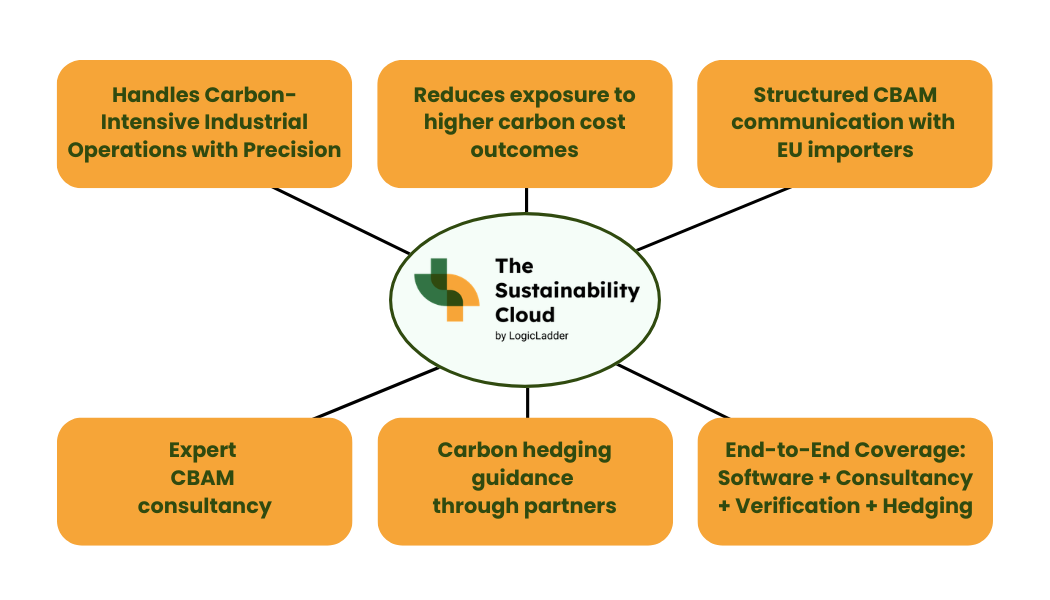
The Sustainability Cloud (TSC) is designed specifically for this.
1. Handles carbon-intensive industrial operations with precision
Brazil’s steel, aluminium, and cement industries are energy-intensive, with emissions varying significantly across plants, fuel sources, and production routes. TSC maps emissions at an installation and process level, ensuring accurate calculations that reflect actual production — helping exporters present more precise data to EU buyers.
2. Reduces exposure to higher carbon cost outcomes
In sectors where margins are already tight, even small differences in reported emissions can significantly impact CBAM costs. TSC enables granular, product-level calculations, helping exporters avoid unnecessary cost increases linked to simplified or default reporting approaches.
3. Structured CBAM Communication with EU Importers
TSC digitises the exporter–importer data exchange, giving your EU customers exactly what they need for their CBAM declarations. Other software leaves this critical link to emails and spreadsheets.
4. Expert CBAM consultancy
TSC pairs its software with seasoned CBAM Consultants who help map emission sources, align with EU-approved methodologies, assess de minimis thresholds, and plan for the 2028 scope expansion. No competitor in this country’s market offers this combination.
5. Carbon hedging guidance through partners
CBAM certificate costs are directly linked to EU ETS carbon prices, which fluctuate. TSC connects clients with specialist partners for carbon price hedging strategies, protecting exporters from cost spikes in a way no other regional software does.
6. End-to-End Coverage: Software + Consultancy + Verification + Hedging
Most software options in this market offer one layer of CBAM compliance. TSC offers all four: automated CBAM software, expert consultancy, partner-led verification, and hedging support. For exporters who face the full financial weight of the 2026 definitive regime, this is a very critical necessity to stay ahead of the competition.
Exporters who can provide accurate, verified emissions data will have an advantage on pricing, trust, and long-term contracts. Those who can’t will find themselves dealing with higher costs, tougher negotiations, or being replaced altogether. The Sustainability Cloud is built to help exporters move fast, from understanding CBAM to actually managing it, with the systems, support, and expertise needed to stay competitive.
Trusted by 1000+ clients over the last 15 years, offering the only end-to-end CBAM solution that combines purpose-built software, expert consultancy, accredited verification support through partners, and carbon hedging guidance all under one roof.
Your competitors are getting ready, are you? Get a free demo today, no strings attached. Talk to our team today at thesustainabilitycloud.com