
CBAM data from the European Commission shows an 8% to 53% jump from 2023 to mid-2025 in the use of actual emissions vs default industry values. All thanks to importers working closely with suppliers to obtain real emissions information.
While EU CBAM American manufacturers may easily purchase CBAM certificates, chances of verification hiccups are possible early on. The root causes are miscalculated emissions calculations and supplier data collection via fragmented reporting workflows. As more EU buyers prepare for the onset of CBAM, American manufacturers are realizing that supplier selection costs and quality can affect their reporting goals.
This article examines the five areas where US exporters remain most exposed and what compliance-ready American manufacturers are tweaking before 2027.
Did You Know: Companies are already trying “dry runs” to test their data collection systems before monetary penalties scale up.
Why EU CBAM Is Creating New Data Demands for American Manufacturers ?

European importers have spent the last two years building their CBAM reporting process. Though reporting obligations sit with the importer, emissions data often comes from the manufacturer. Thus, many US exporters will receive requests for information rarely tracked at this level before.
Firstly, CBAM compliance in the USA ties carbon costs to reported emissions. The quality of emissions data now has direct financial implications for importers.
Secondly, importers are pressured to submit emissions figures supported by actual, installation-specific primary data. Information that may have been accepted during the early stages of the CBAM report is subjected to tighter inspection.
Finally, procurement teams are now seeing emissions transparency as part of supplier reporting maturity. Manufacturers that can respond on-demand to emissions data requests and explain their numbers may be in a steadier position than those relying on estimates and disconnected spreadsheets.
5 Areas Where Most US Exporters Are Still Unprepared for:
Here’s what data to keep readily accessible when trying to comply with EU CBAM from the USA:
Map Highest-Risk CBAM Product Lines
An alarming number of US manufacturers still view CBAM as a company-wide issue rather than a product-level commercial issue. A steel producer may export 50 product categories to Europe, yet have minimal data on which products generate the highest embedded emissions.
Take two hot-rolled coil products leaving the same mill. One may contain 85% scrap feedstock and be produced through an electric arc furnace route. Another may rely on virgin inputs and additional downstream processing. Both leave the facility under the same company name, but the emissions profile attached to each tonne can differ materially.
Avoiding EU carbon border tax exports requires USA manufacturers to combine data that’s rarely together in one place:
- Electricity consumed per production line
- Natural gas usage
- Scrap ratios
- Finished goods volume
- Export shipment records
This is where The Sustainability Cloud’s CBAM Exporter software comes in handy. Rather than stitching together production-line energy data, American manufacturers can centralize product-level emissions. Such tools let companies automate data collection with pre-installed formats and share quarterly reports with EU importers for each exported product.
Match Commercial Shipment Data to Plant-Level Emissions
A manufacturer may know exactly how much electricity an Ohio facility consumed during a quarter. However, connecting that information to specific export shipments sent to Germany, France, or Belgium is a largely different practice altogether.
This gap is mainly flagged in businesses operating through multiple production lines and reworked facilities. And if your products move through more than one facility before export, the related emissions must be reported categorically as well.
Redesign Legacy Manufacturing Systems for CBAM
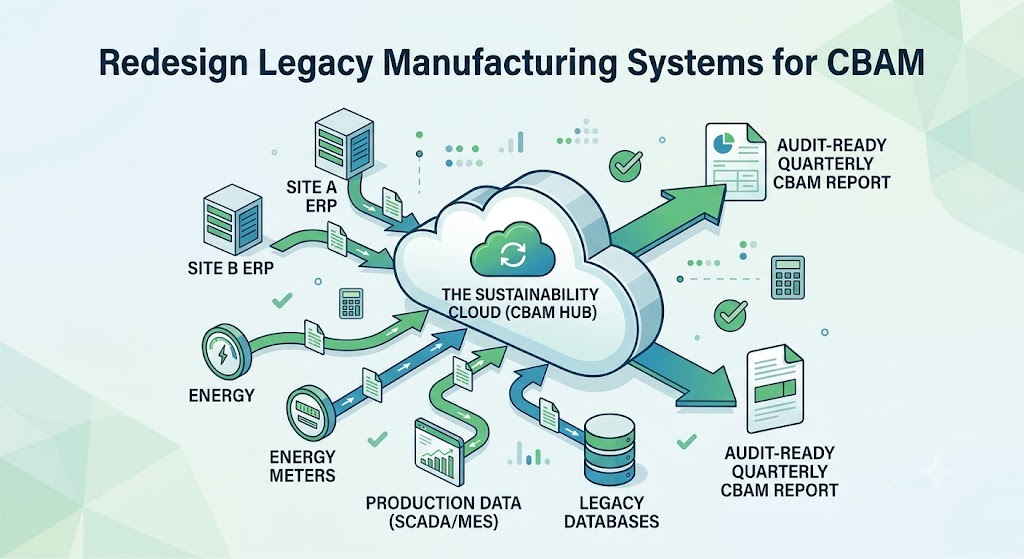
An acquisition completed ten years ago may still operate on a separate ERP platform. In fact, a US manufacturing plant may store production data points in one system at site A and utility records at site B. Many still try to bifurcate environmental records from the beginning. Moreover, even though the company is the same, facilities might classify products and energy consumption in different recording formats.
None of these issues creates major problems in traditional sustainability reporting because information is usually aggregated at the company level. However, CBAM nudges businesses toward product-level carbon accounting, exposing intricate data-reporting loopholes that have existed in manufacturing systems for years.
Stop Treating CBAM as an Environmental Compliance Issue
This is a very American manufacturing problem. Historically, they’ve tried to maintain environmental, operations, and sales teams to handle EPA reporting, production, and customers, respectively. But EU CBAM regulations cut across all three.
For example, a European customer negotiating a multi-year steel contract may begin requesting emissions disclosures alongside lead times and quality specifications. Suddenly, commercial teams are involved in conversations that previously sat entirely with EHS or CSR and sustainability functions.
Many US manufacturers are still trying to build internal processes to respond to these requests. Consequently, conflicting data and slow response times choke them when trying to meet EU CBAM regulations.
If you’re an EU importer, consider The Sustainability Cloud’s CBAM compliance software to decarbonize your global supply chain. Even better, predict carbon taxes and accordingly rethink your supplier partnerships through audit-ready emissions reports.
Assess How CBAM Can Raise Customer Profitability
Almost nobody writes about this, though energy-carbon market experts consult on it.
A manufacturer may know its largest European customers by revenue. It may not be clear which customers are leaking profits because of higher carbon exposure.
Let’s consider two customers purchasing identical product volumes. One sources material from a low-emissions facility with high recycled content. The second sources from a more carbon-heavy production channel. Although the revenue may look identical on paper, the future carbon exposure attached to those sales is not.
As CBAM makes costs more visible, exporters will keep noticing that certain products and customer relationships carry more erratic customer implications than before. If your company isn’t mapping these exposures, you’re probably operating without knowledge of where future margin stress could arrive.
What EU CBAM American Manufacturers should do Are Doing Before 2027
Here’s what your organization can do to successfully meet CBAM compliance in the USA:
- Build carbon intelligence around products: Leading exporters are slowly starting to recognize the carbon profile of individual product families and export averages. Simply relying on on-site wide averages can financially backfire.
- Treat carbon data like financial data: American manufacturers that are further ahead in their CBAM preparation are borrowing principles from financial reporting. From data ownership to source records and statistical changes, they’re all defined.
- Change contract language: Some European buyers are starting to add emissions-related provisions and data-sharing needs in supplier agreements. Others are stressing on calculations and overlooking the contractual obligations around them.
Whether your company has steel mills or fertilizer plants, expect a verifier to visit your facilities. They may verify how production data originates and penalize any leaks in your operational data calculation methods. Either way, exporters that start preparing for the EU Carbon Border Adjustment Mechanism USA 2026 now will likely face fewer surprises in the near future.
FAQs