Companies usually start searching for carbon accounting software in India when spreadsheets can no longer keep pace with growing reporting requirements. Meanwhile, frameworks such as BRSR, IFRS S2, and CBAM continue to raise expectations around reporting accuracy, traceability, and compliance readiness.
CFOs are then left evaluating carbon accounting software the same way they assess financial systems. Scalability, control, audit-readiness, long-term costings; all the essentials for a high ROI. So, let’s now explore the key criteria enterprises use when selecting carbon and GHG accounting software in India. This will enable businesses to choose GHG reporting software that accounts for every emission across the value chain.
Why Carbon Accounting Software in India should be a CFO Priority?
Several business and regulatory developments have pushed carbon accounting beyond sustainability and into the CFO’s office. Here’s why:
- Investor expectations: Climate disclosures are increasingly expected to be backed by verifiable and audit-ready data.
- Growing disclosure requirements: Frameworks such as IFRS S2 are increasing expectations around reporting accuracy, consistency, and governance.
- BRSR compliance: Emissions data often sits across multiple departments, making coordination and reporting more complex.
- Scope 3 pressures: Supplier emissions data is becoming one of the largest reporting challenges for enterprises.
Questions CFOs are asking when choosing between Carbon Accounting Software in India 2026:
Here’s what to ask as a CFO when choosing a suitable carbon accounting platform for Indian enterprises to automate Scope 1, 2, and 3 reporting:
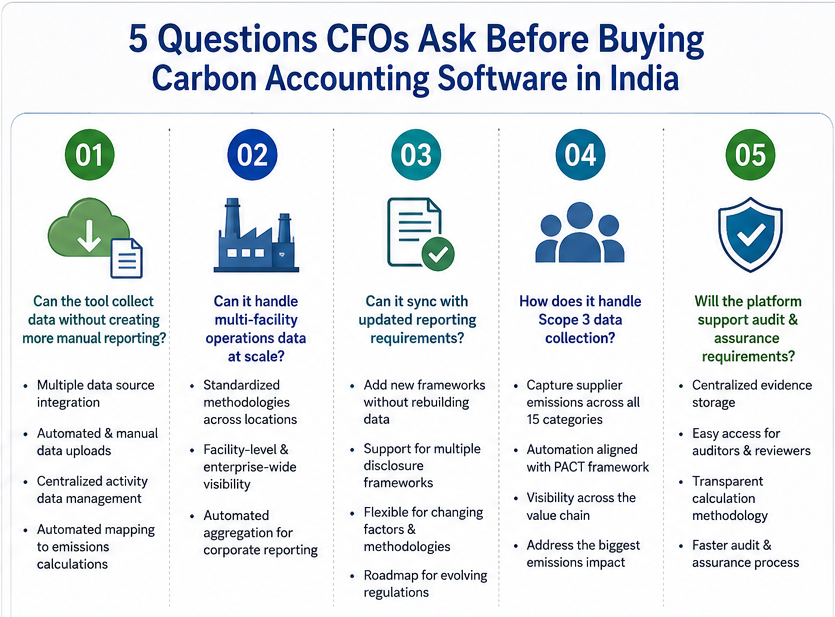
1. Can the tool collect data without creating more manual reporting?
CFOs are investing more time in researching how much of the data collection process can be automated and standardized. While looking for a carbon accounting software, one should look for:
- Ability to collect data from multiple sources, including power bills and consumption records, ERP systems, and procurement platforms
- Support for both automated integrations and manual data uploads
- Centralized management of activity data across facilities and business units
- Automated mapping of activity data to relevant emissions calculations
The overall objective is to reduce the operational effort needed to produce compliant emissions data month after month. Softwares like The Sustainability Cloud’s ESG Net Zero introduces carbon ledger and dedicated activity type ledgers creation features that retain emission sources and calculation methods. This maintains granularity and trail history of the data which can also help in 3rd part verifications and assurance.
2. Can it handle multi-facility operations data at scale?
A manufacturing group with ten facilities may have ten different teams collecting energy data and maintaining records. This often leads to inconsistent reporting methodologies, making enterprise-wide emissions reporting difficult to standardize.
Our experts at The Sustainability Cloud recommend that CFOs look for sustainability-based SaaS tools with:
- Standardized calculation methodologies across locations
- Facility-level visibility alongside enterprise-wide reporting
- Automated aggregation of emissions data for corporate disclosures
3. Can it sync with updated reporting requirements?
As regulatory frameworks continue to develop on a national and international level, a company that currently reports only Scope 1 and Scope 2 emissions may later need particular supplier-level Scope 3 metrics.
Hence, your existing ESG reporting software should be able to assess:
- Whether new reporting frameworks can be added without rebuilding data structures
- Support for multiple disclosure frameworks from a common dataset
- Flexibility to accommodate changing emission factors and methodologies
- Roadmaps for newer reporting requirements and regulations
A platform may satisfy today’s reporting obligations but a more important question is whether it can support the next 5 years of disclosure requirements without creating another software selection project. The Sustainability Cloud addresses this challenge by allowing organizations to use a common emissions dataset with different updated versions across frameworks such as BRSR, IFRS S1/S2, GRI, CDP, and CBAM. This reduces rework when reporting requirements change and helps enterprises maintain consistency across multiple disclosures.
4. How does it handle Scope 3 data collection?
A company may have visibility into its own power consumption statistics, but it can’t access similar upstream data on the supplier side.
A research project by Carbon Disclosure Project (CDP) and Boston Consulting Group (BCG) highlighted that a corporation’s supply chain emissions are at least 26 times higher than its direct operational emissions (Scope 1 and Scope 2). ESG metric-tracking tools let you oversee Scope 3 emissions across your company’s value chain. The Sustainability Cloud’s NetZero automates the mathematics for all 15 categories and helps you stay in sync with the PACT framework.
5. Will the platform support audit and assurance requirements?
Sustainability disclosures are always under the supervision of VVBs and other ESG-related regulatory bodies. This compliance-powered oversight needs companies to explain how their emissions numbers were derived and where the source data originated from.
One should prioritize ESG SaaS tools with features like centralized storage of supporting evidence. Also, the easier access for auditors and internal review teams, the lower the chances of re-verification. Consider The Sustainability Cloud’s GHG reporting software to get instant access to partnered verification service providers.
As climate disclosures become more integrated with business reporting, CFOs are preferring carbon accounting software as long-term operational infrastructure rather than standalone sustainability tools. Remember, the most successful investments help organizations spend less time managing data and more time acting on it.
Calculate your embedded emissions with our CBAM reporting software for exporters