
Across Kuwait’s capital markets, ESG reporting is shifting from a good intention to a genuine strategic differentiator. The companies building that capability today won’t just meet expectations, they’ll set the benchmark for everyone else.
A quiet but significant shift is underway in Kuwait’s capital markets. Boursa Kuwait’s 2026 ESG Reporting Guide, aligned with CMA Resolution No. 136/2022, has set a clear direction: Premier Market companies are expected to disclose sustainability reports covering financial year 2025 before the end of Q2 2026. For the broader market, the guidance is strong and the trajectory is unmistakable.
But this isn’t simply a compliance exercise. It’s a genuine inflection point. The listed companies that invest in ESG reporting infrastructure now will have cleaner data, stronger investor relationships, and a credibility advantage that compounds over time. Those that treat it as a last-minute checkbox will spend more, produce less, and start from behind every reporting cycle.
Here’s what forward-looking companies in Kuwait need to understand, and act on.
What ESG Reporting actually covers?
Boursa Kuwait’s guide is specific and structured. It isn’t a vague call to “be sustainable”, it defines a clear set of metrics across three pillars that companies are expected to track, measure, and disclose:
| Environmental | Social | Governance |
| GHG emissions (Scope 1 & 2) | Employee turnover by type | Board independence |
| Scope 3 where material | Gender diversity (all levels) | CEO / Chair separation |
| Energy consumption & intensityEnvironmental policies | Health & safety injury rates | Supplier codes of conduct |
| Water usage | Local hiring disclosures | Anti-corruption compliance |
| Renewable energy mix | Human rights policies | Data privacy frameworks |
| Training hours per employee | External ESG assurance |
That is a meaningful data collection exercise, one that touches HR, finance, operations, procurement, and the boardroom simultaneously. The companies that start building this now will have a full year of clean, structured data to work with. Those that start in Q1 2026 will be scrambling to reconstruct it.
The investor opportunity is real
This isn’t just about satisfying a regulator. The global capital allocation story has shifted fundamentally. Institutional investors: pension funds, sovereign wealth funds, ESG-focused asset managers, are integrating sustainability data into every investment decision they make.
For Kuwait’s listed companies, this represents a direct opportunity. Kuwait is actively positioning itself to attract foreign institutional capital. A company with transparent, credible, internationally-aligned ESG disclosures is a company those investors can underwrite with confidence.
“Companies transparent about sustainability are better positioned to access capital from ESG-focused funds and be included in sustainability indices.
There is also Kuwait’s own 2060 carbon neutrality commitment shaping the longer arc. Energy companies, banks, real estate developers, and industrial firms listed on Boursa Kuwait will increasingly be judged on how seriously they are preparing for that transition. ESG reporting is how you make that preparation visible and credible to the investors who matter.
Why data infrastructure is the real challenge?
Most companies in Kuwait don’t have a strategy problem with ESG. They have a data problem. The willingness to report is there. The systems to collect, calculate, and verify that data reliably often aren’t.
Many companies attempt their first ESG report manually pulling numbers from different departments into a shared spreadsheet, estimating what can’t be measured, and hoping it holds together under scrutiny. It rarely does. Spreadsheets don’t maintain audit trails. They can’t enforce consistent methodologies across business units. And when an assurance provider asks to trace a number back to its source, a spreadsheet offers no defensible answer.
Boursa Kuwait’s guide explicitly recommends third-party assurance of key metrics, especially GHG emissions and injury rates. You cannot assure data you cannot trace.
| Capability | Manual / Spreadsheet | ESG Platform |
| Data collection & consolidation | Fragmented, email-based | Automated, centralised |
| GHG calculation | Error-prone, inconsistent, manual | Automated calculation, Protocol-aligned, auditable |
| Framework mapping | Manual cross-referencing | Built-in (GRI, IFRS S1/S2, SASB) |
| Assurance readiness | Difficult to trace | Structured, traceable |
| Year-over-year consistency | Breaks with personnel changes | Systematic and repeatable |
| Approval workflow | No controls, no audit trail | Role-based maker & checker workflow |
| Integration & performance tracking | Siloed, static snapshots | System integrations, real-time dashboards |
The difference isn’t just efficiency. It’s the difference between a report that builds market credibility and one that quietly undermines it.
What The Sustainability Cloud Gives You
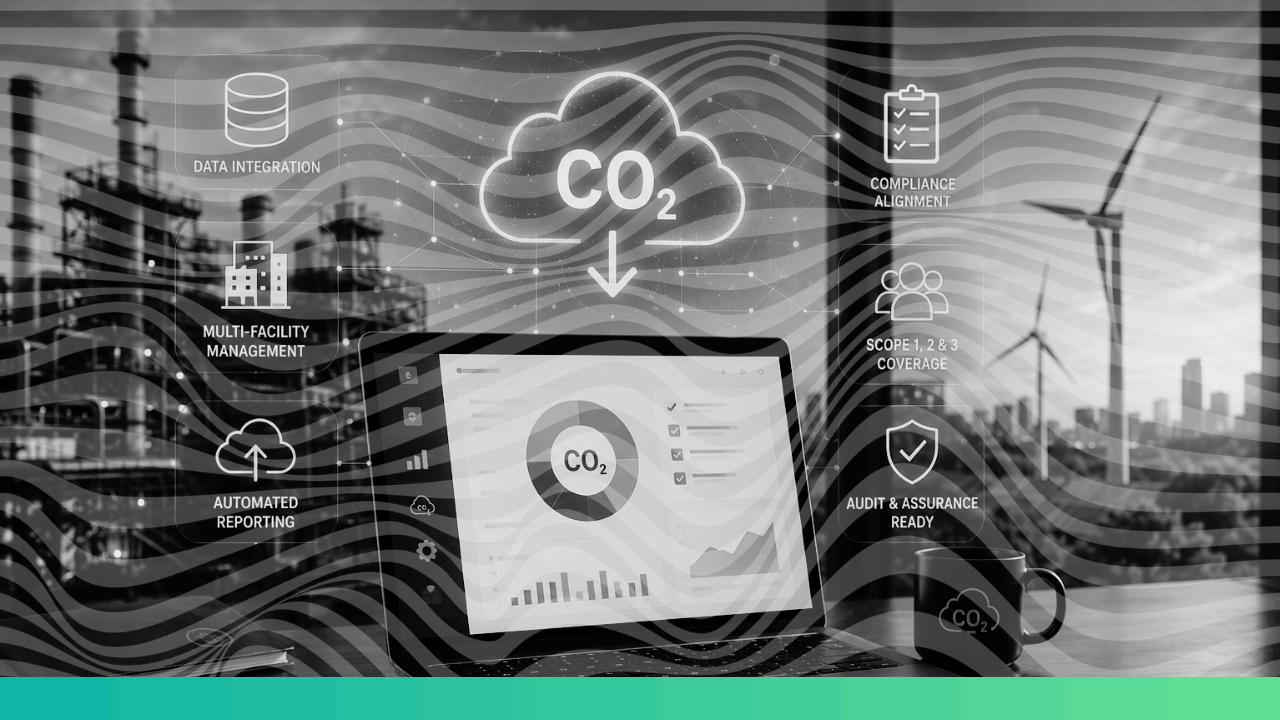
The Sustainability Cloud is purpose-built to solve exactly this challenge, giving listed companies the infrastructure to report with confidence, starting now and scaling as expectations grow.
- Carbon accounting Aligned with the GHG Protocol, covering Scope 1, 2, and Scope 3 categories.
- Automated data collection Across departments and subsidiaries, with consistent definitions that hold up year after year without manual reconciliation.
- Framework mapping To GRI, IFRS S1, IFRS S2, TCFD, and SASB, so your disclosures speak the language institutional investors actually use.
- Assurance-ready outputs Structured, traceable data your external verifiers can work with efficiently, not a spreadsheet they need to reverse-engineer.
- Maker & checker workflow Role-based approvals ensure data goes through the right hands before it’s disclosed, critical for governance and internal accountability.
- Real-time dashboards & integrations Connect with existing systems and track ESG performance as it happens, not just at reporting time.
The platform is built on globally recognised standards, the same frameworks that Boursa Kuwait’s guide references and that international investors rely on. Whether you’re a Premier Market company facing an imminent disclosure requirement or a Main Market company getting ahead of the curve, the infrastructure is the same.
The leaders are already building this capability.
Book a demo and see how The Sustainability Cloud helps Kuwait-listed companies report with confidence — starting with the data they already have. Kuwait’s ESG reporting landscape is still early enough that first movers will define what good looks like. The companies that build robust reporting infrastructure now won’t just meet the next disclosure requirement — they’ll be the ones investors point to as the standard.