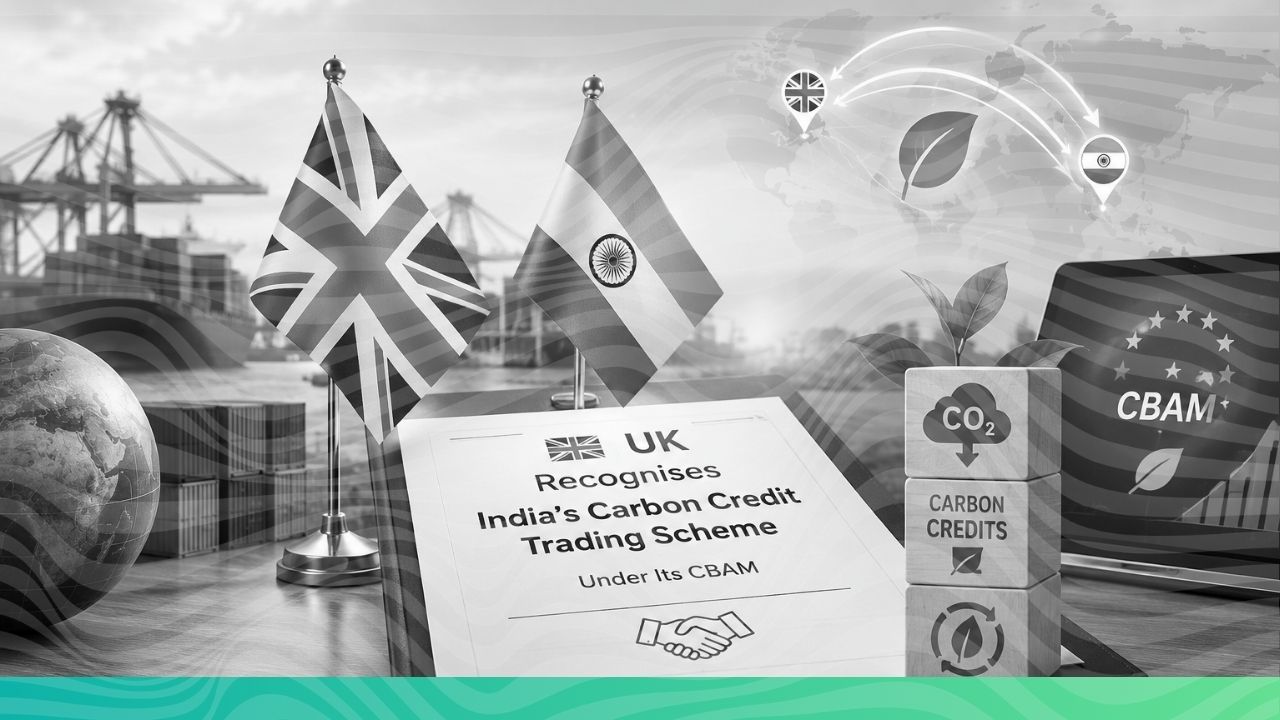

Under the UK CBAM, India CCTS recognition marks a major policy shift. For months, Indian exporters watched the UK’s Carbon Border Adjustment Mechanism (CBAM) — set to kick in from 2027 — with a fair bit of anxiety. Steel, aluminium, cement, fertiliser and other carbon-intensive exports to Britain were staring at an added carbon cost, with no formal way to offset the carbon price already being paid back home.
That’s changed. The UK government has officially included India’s Carbon Credit Trading Scheme (CCTS) in its list of qualifying carbon pricing mechanisms under UK CBAM.
This isn’t a media report of an off-the-record government briefing – it’s published, on the record, by HM Revenue & Customs on GOV.UK, in the official list of “current qualifying carbon pricing schemes” under UK CBAM. The Indian Carbon Credit Trading Scheme (CCTS) now sits alongside 14 other recognised schemes, including the EU ETS, China’s national ETS, and Japan’s GX-ETS.
What the UK CBAM India CCTS Recognition Means
The recognition means UK importers of eligible Indian goods can now claim carbon price relief corresponding to the effective carbon price those goods have already borne under India’s CCTS – subject to evidence and verification requirements laid down under UK law. In effect, it lowers the CBAM liability that would otherwise apply on those goods, and the benefit flows straight through to Indian exporters in the form of a smaller cost disadvantage.
The move follows sustained technical-level engagement between the Ministry of Commerce and its UK counterpart on how the CCTS is designed and implemented – with HM Treasury separately confirming the recognition in a communication to India’s Bureau of Energy Efficiency. It reflects a principle the UK has been fairly consistent about: CBAM is meant to avoid double taxation on goods that have already borne a comparable carbon price in their country of origin. With this recognition, that principle now formally extends to India.
The qualifying criteria themselves are set out in The Carbon Border Adjustment Mechanism (Calculation of CBAM Rate and Determination of Carbon Price Relief) Regulations 2026 – the underlying legislation HMRC assessed the CCTS against.
It’s also a bit of a signal for the road ahead. India has been pushing for similar recognition in its ongoing trade conversations with the EU, where CBAM compliance is already live and considerably more consequential for exporters. A precedent like this – one carbon pricing mechanism formally validating India’s CCTS – strengthens that case.
Why This Matters, Beyond the Headline
Under the new UK CBAM India CCTS framework, exporting carbon-intensive goods to the UK becomes more structured, but it’s not automatic relief. The word doing the heavy lifting in the official language is “evidence.” To actually claim the carbon price relief, exporters will need to demonstrate – with defensible, auditable data – exactly what carbon price their goods have borne under the CCTS.
- Traceable carbon accounting at the product and facility level, not just a corporate-wide number
- Documentation that maps cleanly to CCTS obligations – the certificates, compliance targets, and pricing that apply to your sector
- Verification-ready records, since UK authorities will be checking claims against prescribed evidence standards
- A process that can keep pace with new guidance, because as both UK CBAM and India’s CCTS mature, the rules for what counts as sufficient evidence will keep getting refined
In other words, the opportunity is real, but it rewards exporters who already have their carbon data in order – and it penalises those who are still tracking emissions in spreadsheets when the evidence request lands.
How TSC Helps
This is exactly the gap The Sustainability Cloud (TSC) is built to close.
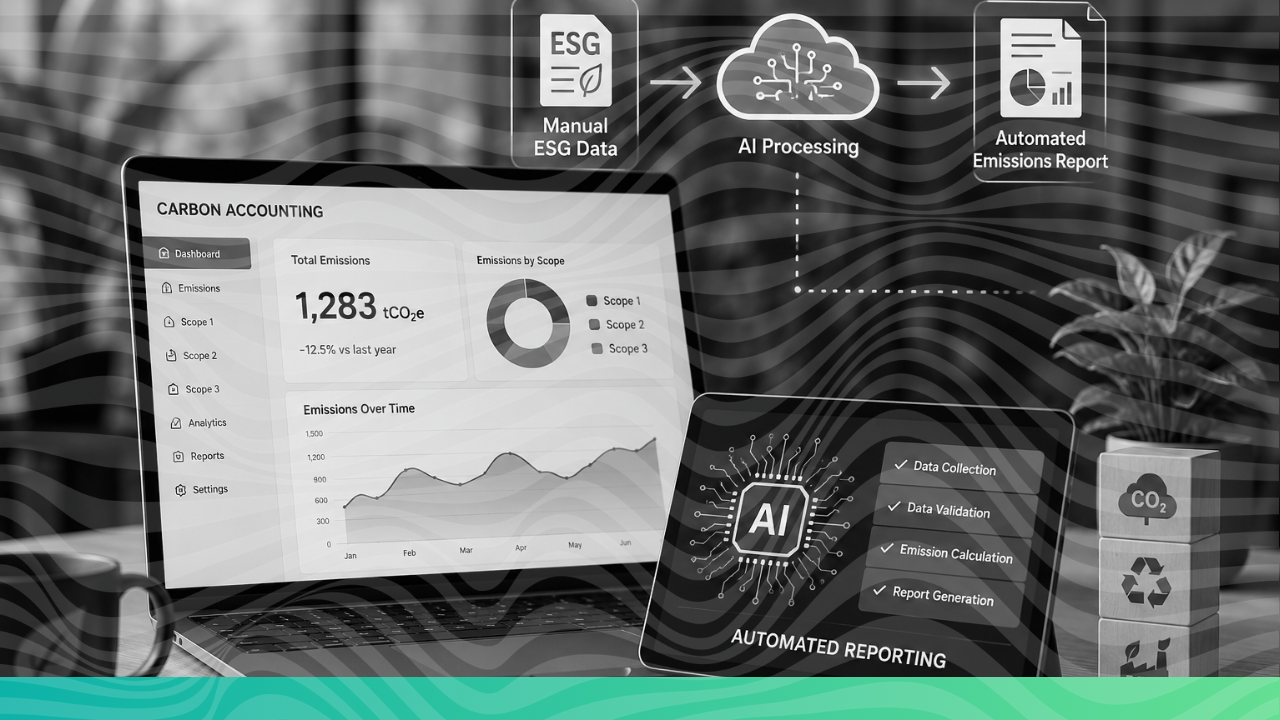
TSC’s carbon accounting engine gives exporters facility- and product-level emissions data that’s traceable back to source activity data, not just modelled at a high level – which is the difference between a number you can report and a number you can defend under verification.
For companies navigating cross-border carbon compliance specifically, TSC’s CBAM Exporter module is designed to:
- Calculate embedded emissions in line with the applicable CBAM methodology, so the numbers hold up whether the counterpart is the EU, the UK, or a future scheme
- Maintain the evidence trail – source data, calculation logic, and supporting documentation – in a form that’s ready when a buyer or authority asks for verification
- Keep pace with regulatory change, so when guidance is updated (as it regularly is, on both the CBAM and CCTS sides), your reporting doesn’t have to be rebuilt from scratch
- Give sustainability and finance teams a single system of record instead of reconciling numbers across spreadsheets, consultants, and one-off audits
The UK CBAM India CCTS alignment is a major step toward fairer, less punitive cross-border carbon rules for Indian exporters. But the exporters who actually capture that benefit will be the ones who can produce clean, verifiable carbon data on demand. That’s the part TSC is built to handle – so when the next market recognises your carbon pricing, or the evidence bar moves again, you’re not scrambling to catch up.
Want to see how TSC’s CBAM Exporter module can get your carbon data audit-ready? Get in touch with our team.
Source: HM Revenue & Customs, Carbon Border Adjustment Mechanism: List of current qualifying carbon pricing schemes, GOV.UK, published 27 August 2026.
FAQs
It means UK importers of eligible Indian goods (like steel, aluminium, cement, and fertilisers) can claim carbon price relief against their UK CBAM liability for the carbon price already paid under India’s CCTS. This reduces the risk of double taxation and makes Indian exports more competitive in the UK market.
The UK Carbon Border Adjustment Mechanism (CBAM) is scheduled to take effect from 2027. It applies to carbon-intensive sectors, requiring UK importers to declare and pay for the embedded emissions of imported goods, unless carbon pricing relief is successfully claimed.
No, relief is not automatic. Exporters must provide verifiable, audit-ready data demonstrating the exact emissions and the corresponding carbon price paid in India under the CCTS. Without granular evidence, importers will not be able to claim the offset.
Corporate-level carbon accounting provides a high-level aggregate of an entire company’s emissions. Product- and facility-level data tracks emissions to specific manufacturing processes and activity sources—which is the level of detail required by UK and EU CBAM regulators for verification.